Showing posts with label Nashville. Show all posts

Friday, August 6, 2010

Unskilled labor!

This post provides additional visual evidence from a time when America needed to quickly ramp up a big high-tech workforce. We turned to a largely unskilled group of citizens to fill the need. The prior post has related commentary.

Prior post presented images taken in Nashville. This post has two from Nashville and photos taken in six other cities.

Welcome to America, 1942-1943


Click any image to see it full size
Vultee Aircraft - Nashville, Tn. - 1942

 A.C. Gilbert Company, New Haven, Ct. - Feb 1942

"Stephanie Cewe's skill with this electric screwdriver has been turned to the aid of Uncle Sam's war machine. Stephanie used to assemble toy locomotives; today, she uses the same screwdriver to assemble parachute flare casings." Photo by Howard Hollem, Office of War Information.

 Douglas Aircraft, Long Beach, Ca. - Oct 1942

"Women are trained as engine mechanics in thorough Douglas training methods." Alfred Palmer, Office of War Information.
Click any image to see it full size
Corpus Christi, Texas. - Aug 1942
"Mrs. Eloise J. Ellis, senior supervisor in the Assembly and Repairs Department of the Naval Air Base, talking with one of the men." Howard Hollem.

Douglas Aircraft, Long Beach, California - Oct 1942.

"Women are trained to do precise and vital engine installation detail in Douglas Aircraft Co. plants." Alfred Palmer for the Office of War Information.

 Heil & Co., Milwaukee, Wis. Feb 1943

"Agnes Cliemka, age 23, husband may be going into the service any day. Agnes used to work in a department store. Checking fuel hose on gasoline trailer before it is turned over to the Air Force." Howard Hollem.

Chain Belt Company, Milwaukee, Wis. - Feb 1943

"Mrs. Mary Betchner measuring 105mm howitzers at the Milwaukee, Wisconsin, plant of the Chain Belt Company. Her son is in the Army; her husband and daughter are in war work." Howard Hollem for the Office of War Information.
Click any image to see it full size
 North American Aviation, Inglewood, Ca -1942

Riveting team working on the cockpit shell of a C-47 heavy transport at North American Aviation. "The versatile C-47 performs many important tasks for the Army. It ferries men and cargo across the oceans and mountains, tows gliders and brings paratroopers and their equipment to scenes of action." Alfred Palmer for the Office of War Information. 

Douglas Aircraft, Long Beach, Ca. - Oct 1942

"Girl riveting machine operator at the Douglas Aircraft Company plant joins sections of wing ribs to reinforce the inner wing assemblies of B-17F heavy bombers." Alfred Palmer for the Office of War Information.

 Consolidated Aircraft, Fort Worth, Tx - Oct 1942

Riveter at work on a bomber. Howard Hollem.

Consolidated Aircraft, Fort Worth, Tx.- Oct 1942

Lathe operator machining parts for transport planes. Howard Hollem, Office of War Information.
Click any image to see it full size
Vultee Aircraft, Nashville, Tn. - Feb 1943

Readying a "Vengeance" dive bomber for landing gear installation. Alfred Palmer. 

 Douglas Aircraft, Long Beach, Ca. - Oct 1942 

Engine installers. Alfred Palmer.

******************************************
Images without captions: Library of Congress
Images with captions: Shorpy
******************************************

Thursday, August 5, 2010

Unskilled labor?

The immigration debate shouldn't even be a discussion. This is America, immigration is what we do. TheRaven previously explained immigration as both a moral cause and a saving grace with a look at the  unpleasant demographic alternative called "Europe". This post looks at anti-immigrant hysteria from a different angle.

There's a persistent myth that immigrants can't be trained for new vocations. The Right assumes that adults from low-tech environments lack the background necessary to acquire high-tech skills. Such assumptions are proclaimed as fact and spewed at a credulous, white audience. America's history refutes this notion several times over. This post provides only one example, in only one city, with a series of images obtained from the Library of Congress.

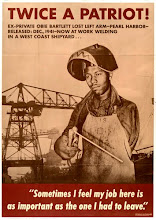
Three generations ago, America turned to its largest pool of unskilled people to fill a massive need for high-tech manufacturing labor. Recruiting an enormous army & navy while also embarking on an unprecedented surge in military manufacturing caused social norms to be tossed aside. The vast majority of this new manufacturing army had never held a wrench, power tool or had previously seen the inside of a factory, let alone operate hydraulic presses or master difficult skills such as welding. Most women who manned our factories during WW2 had zero prior experience with any manufacturing process, tool or concept because they were previously "housewives".

Welcome to Nashville, 1942.

Vultee Aircraft (California) bought Stinson Aircraft Corp. in 1940. Vultee paid $2.3 million for Stinson and got a recently completed, $2 million factory in the deal. A Time magazine report on the transaction noted Tennessee's "plentiful labor" and speculated that Vultee might expand the Stinson workforce ten-times over, to 7,000 employees. Time didn't mention that such expansion would depend heavily on a female work force.
These photos were taken for the Army in August 1942 and February 1943. While these photos appear to be staged, the women were genuine workers.
Click any image in post to view full size
The wartime economy caused the US female manufacturing workforce to roughly quadruple in just a few years. The Arsenal of Democracy legacy was built in large part by "a bunch of housewives", some of whom began their wartime employment with fewer job skills than less educated immigrants possess today.

Vultee went through several changes in ownership and was acquired by Vought in 2003. The original Vultee plant has grown to 2.1 million square feet. Aircraft components have been produced for over 70 years at 1431 Vultee Boulevard, Nashville, Tennessee. The legacy of a quickly-skilled workforce that made a big contribution lives on in Nashville, but not in the hearts or minds of Right-wing demagogues.

All photos: Library of Congress

Friday, June 4, 2010

Journalism that reeks

This New York Times article feels good at first blush. The headline news is that Wal-Mart will spend $50 million with an online university, in a new program that supports higher education attainment for rank and file employees. In actuality, Wal-Mart got greater value in free publicity from a credulous New York Times.

American Public University (APU) is headquartered in Charles Town, West Virgina (not to be confused with Charleston), a 1.4 square mile hamlet of less than 3,000 people. APU is Wal-Mart's chosen education partner. Wal-Mart claims that a survey of 32,000 of its employees revealed a strong preference for online education. The Times piece isn't completely amiss. One can deduce that Wal-Mart's low-paid workforce (averaging under $12/hour) will bear the brunt of their education costs. This puts the onus on Wal-Mart to procure cost-effective education for its workforce.

Charles Town is most famous as the place where John Brown was tried and hanged, in 1859. Almost 16% of its population lives below the poverty line. Charles Town has no infrastructure or geographic positioning relative to higher education. A Google Earth view of Charles Town suggests that APU may be located in a residential structure (Google Street View isn't available for Charles Town):

Click image to view full-size
To be fair, APU says its back office operations are located in Manassas, Va. The point on headquarters location pertains to the unlikely confluence of higher-education institutional leadership in a small West Virginia town (that otherwise has nothing to do with higher education).

The times article claims APU has 70,000 students while APU's own website says "...more than 50,000 students in 100 countries.." (a discrepancy of 40%). American Public University is owned by American Public Education, Inc., a NASDAQ listed corporation. The Times article doesn't mention this. From the APEI website: 

American Public Education, Inc. (NASDAQ: APEI) is a leading provider of online post-secondary education focused primarily on serving the military and public service communities. American Public University System (APUS), wholly owned by APEI, comprises two universities: American Military University and American Public University (APU)....APUS serves more than 63,800 adult learners worldwide......In 2002, American Public University was founded.

APU is only eight years old? The Times didn't mention that, either. Based on APEI's financial statements, explosive growth over the past few years has created a cash machine:

  • Revenue grew over 5x from 2005 to 2009.
  • 2009 revenue was $148 million
  • 2009 after-tax margin was 16%
  • 36% return on equity
  • 2010 1st quarter revenue grew 43% over 2009
  • 2010 1st quarter cash flow doubled over 2009
APEI is on-track to become a $200 million corporation this year, generating over $30 million in after-tax profit and about $40 million in free cash flow. If the Times had bothered to read APEI's financials, Wal-Mart's new program wouldn't have been conflated with "wide influence" accruing to a huge employer. Wal-Mart's planned annual tuition assistance budget is only 8% of APEI's probable 2010 revenues. (APEI is also located in Charles Town).

Purely online education has a well-earned reputation for recruiting abuse, student loan fraud and lack of academic rigor. Accreditation and academic worth do not correlate. There are twelve decidedly mixed reviews of American Public University here from current and former students. This sample alone isn't enough to provide a basis for conclusions but the negative comments have an uncomfortable ring of truth.  

University of Phoenix is the big gun of online colleges. It grew explosively in its early years and was subsequently the target of lawsuits and investigations into abuse and fraud.  According to this NPR piece, U of Phoenix anticipated an $80 million fine only last November. Comments posted by current and former students to the NPR piece offer the same disquieting mix of support and derision, in greater volume, with negative comments reinforcing lack of academic rigor as a primary failing. This former U of Phoenix employee has some damning things to say. 

U of Phoenix is not directly connected to APU but its history, similar business model and APU's stellar growth trajectory beg some questions, such as: how did APU grow so fast? The Times wasn't interested in such inquiry and we are left wondering if APU offers genuine education at a fair price. 
  
The core problem lies in this statement: "With the work credits and tuition discount, an associate’s degree for a Wal-Mart or Sam’s Club cashier (from APU) would cost about $11,700 and a bachelor’s degree about $24,000". The Times reporter (or editor) lacked the sense to put a $12 thousand Associate's degree in context. It's doubtful that any Times staffers have ever attended a community college. Very few of them likely attended a public university. An $11,700 Associate's degree must look like a bargain to someone who dropped $200,000 on a degree from Columbia. 

This image points to the problem and perhaps explains some of APU's revenue growth.
APU charges $250 per credit hour, for online-only instruction! Wal-Mart employees will pay 15% less ($212.50), which explains why APU's stated price for a bachelor's degree is $30k while the Times quoted $24k.
  
Wal-Mart estimates that half of its 1.4 million domestic employees are high-school graduates. Given their average pay and Wal-Mart's modest level of support in the new program, the only education options otherwise within reach for most of these 700,000 potential college students is the nearest community college. Therefore, The Times should have compared APU's pricing to community colleges. Such comparison would determine if Wal-Mart had truly acted in the best interests of its employees.
  
Community Colleges are a tried and true model, most have decades of experience turning out graduates who are qualified for careers in technology, health care, business roles, law enforcement or for transfer to a bachelors program. Community Colleges offer flexible scheduling and online education options. They are the original evening education model. The President is a believer and this piece in Slate nails the reason: community colleges have succeeded despite a long-running dearth of Federal support. The $12 billion program announced last year works out to roughly $10 million per school. 

Community colleges are also cost-effective, as shown by these examples:
Here's the key comparison:
  • Average community college cost - $85 per credit hour
  • APU's discounted rate for Wal-Mart employees - $212 per credit hour
To a Times staffer sweating a 6-figure student loan debt, the difference between a $12,000 Associate's degree and a $5,000 alternative must appear trivial. To many Wal-Mart employees earning $12 an hour, it's the difference between higher education and hopelessness. Community colleges aren't a perfect solution but, on balance, the education they provide in real classrooms is superior to comparable instruction offered by  "online universities". 

This post identified key facts that The Times missed. If the journalist had invested 1-2 more hours, The Times could have benefited from public interest in an expose of (take your pick):
  • "Wal-Mart's High Price for Employee Education" 
  • "Wal-Mart Prices Education Out of Employee Reach"
  • "Low-Prices Always? Not for Wal-Mart Employees"
By failing in its journalistic responsibility, The Times became Wal-Mart's unwitting shill. From America's purported newspaper of record, this is journalism that reeks.

UPDATE 1: The Washington Post weighs in here, noting that "For-profit schools may be offering an educational alternative, but that choice often comes with crushing student debt..."


UPDATE 2: Score another win for WalMart. This blogger at theAtlantic gets taken, just like the New York Times.

UPDATE 3: The New York Times published a decent (but small) article that provides online university industry facts & figures, in anticipation of a series of congressional hearings. Senator Tom Harkin has issues a report which states that "profit-making colleges generally charge higher tuition than comparable public colleges, spend a large share of revenue on expenses not related to teaching, experience high dropout rates, and, in some cases, use abusive recruiting and debt management practices." Steven Eisman, a hedge fund manager, has prepared testimony for the hearings and calls the for-profit colleges “marketing machines masquerading as universities.”

UPDATE 4: The Times appears to be catching on to what may be a sensational story of fraud and exploitation, with coverage of a new GAO report. Several undercover operatives documented fraud and deception at 15 for-profit colleges. "...recruiters at four of the colleges encouraged prospective students to lie on their financial aid applications — and all 15 misled potential students about their programs’ cost, quality and duration, or the average salary of graduates...courses in massage therapy and computer-aided drafting that cost $14,000 at a California for-profit college were presented as good values, when the same courses cost $520 at a local community college". The GAO is releasing a video of undercover investigation.


UPDATE 5: The story continues to develop and some ugly outlines are beginning to emerge. This NY Times article provides a key data point:"In the 2008-9 award year, students at for-profit schools represented 26 percent of borrowers — but 43 percent of defaulters. The median federal loan debt for students earning associate degrees at for-profit institutions was $14,000.....Most community college students do not take out student loans". This means that high default rates are driven, at least in part, by "online educators" charging almost 3-times as much for an associates degree as does the average community college. Combined with years of reports of illegal sales tactics and education finance irregularities, this situation has acquired the odor of massive fraud.

Thursday, May 20, 2010

Good governance

The Daily Beast has rated Tennessee the most corrupt state in the union, but Nashville has a current example of good governance, reported here. Mayor Karl Dean and his staff are planning an expansion of a heretofore small buyout program for homes in flood-prone areas. While exact details regarding the scope and operation of  program aren't known, the speed of Nashville's response to the obvious - climate change has increased the severity of floods and reduced the interval between major events - stands in sharp contrast to New Orleans dysfunctional government.

New Orleans has done nothing as areas below sea level have been reclaimed by former residents. This non-response to understandable but misguided human emotions only guarantees future disaster. The highest natural elevation in New Orleans is a mere 12 feet above sea level. New Orleans will not survive the full brunt of climate change and its lower elevations will surely suffer well before the rest of the city is lost.

The article mentions that Nashville's buyout program is voluntary. A perfectly fine approach for homeowners but TheRaven urges a tougher stance on landlords, who may not respond to voluntary incentives with equal alacrity. TheRaven notes that government has two forms of eminent domain at its disposal. The public form creates headlines and lawsuits while stealthy use of rigorous codes enforcement gets results.

With Birmingham mired in scandal and debt, New Orleans sinking and Atlanta drowning in traffic, Nashville is showing another way it can distinguish itself from the Other South. Nashville's biggest long-term problem is crime. If, in addition to forward-thinking on climate change, Nashville solves its crime issues, it will emerge as the south's destination city.

UPDATE: The Nashville Scene reported on the effect urban planning decisions had on the flood in this July 8th article. Apart from local urban planning history, which suggests that Nashville-area builders lived in a "property-rights era" until 1991, the piece makes a telling point about modern safeguards and moral hazard. Only one of Nashville's historic homes sustained meaningful flood damage. Before the era of flood insurance, FEMA and dam systems, folks made better site location decisions. Their potential cost of failure with regards to property investment and floods was absolute.

Sunday, May 9, 2010

500 Year Flood?

Nashville saw flooding to 500-year levels defined by flood maps. Unprecedented 2-day rainfall caused local flooding on Sunday, May 2nd. Tiny streams were inundated by local rainfall...

Click to see full-size image

...and streets were transformed into raging rivers. The next picture was taken in a narrow 100-year flood plain. Water is heading to the Cumberland river, moving fast enough (from right to left) to create rapids. Most houses in this neighborhood were built decades before climate change began to receive press coverage.
Click to see full-size image
  
Sunday was only the 1st part of a two-flood drama, as the water rose around everything that could not or would not move...

Click to see full-size image

Greater damage for some came on Monday. As rainwater poured into the Cumberland from hundreds of creeks, it rose to record levels and crept back into the very neighborhoods that had been inundated with local flooding the previous day. Entire streets vanished under water...

Click to see full-size image

By Monday, the Cumberland had buried East Nashville's airfield. The two planes shown above were shot on Sunday. They were almost completely under water by Monday, meaning that the airfield, normally 20+ feet above the river, was under about seven feet of water. The only visible aircraft that was reasonably above water had been repositioned at the front gate.

Click to see full-size image

Portions of downtown Nashville were under several feet of water, such as 1st street. This shot looks northwest, from Shelby. National reporting hasn't done justice to the severity of the crisis or to the quality of response from local government agencies. While this flood is Tennessee's Katrina, Nashville isn't New Orleans.

Click to see full-size image

Miami radically changed its building code after Hurricane Andrew. It will be interesting to see whether Nashville government realizes that climate change has made old statistical guidance, such as "100-year floodplain" or "500-year flood zone", worthless. TheRaven thinks Nashville government can adapt to the new reality by dropping a zero from flood occurrence designations and changing building codes accordingly. Some areas must revert to nature or receive building prohibitions and features of new construction, such as basements, should be scrutinized for genuine need.

(All photos by TheRaven)